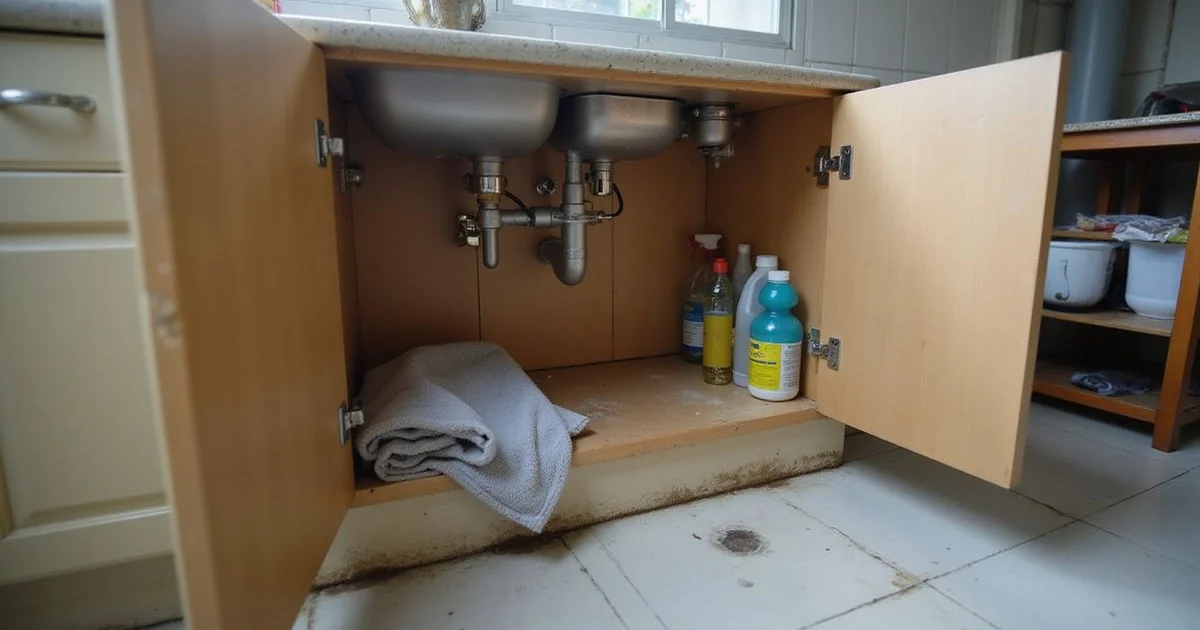
Finding the drip
Leaking under sink cabinets is common, and it’s usually easy to fix once you know where the water starts. The catch is that water runs along pipes and drips from the lowest point, which can sit nowhere near the real leak.
Most of us blame the first wet spot we see. That’s how people end up tightening the wrong nut for an hour.
Below, we cover the usual suspects, a simple dry-and-test method, and the fixes you can try yourself. It’s part of our Taps and Fixtures section.
The usual suspects
Seven parts cause most kitchen sink leaks, and each one leaks at a different moment. Match when your leak shows up to the clue in the table.
| Source | When it leaks | Clue |
|---|---|---|
| Flexible supply hose | All the time, even with the tap off | Damp hose, rust on the braiding, drip at the angle valve |
| Angle valve | All the time | Drip at the valve spindle or connection |
| Tap base | When the tap is running | Water seeps down through the tap hole |
| Sink seal | When the sink is full or splashed | Water around the sink rim underneath |
| Waste outlet | When the sink drains | Drip at the plughole fitting below the sink |
| Waste trap | When the sink drains | Drip at the slip nuts or bottom of the trap |
| Dishwasher or filter hose | When the appliance runs | Wet near the appliance connection |
A sink waste pipe leak is the one we see most. It only shows up when the sink drains, so people often miss it until the cabinet smells damp.
The drying and testing method
Dry everything first, then test one thing at a time. Each step below tells you which part to blame.
- Empty the cabinet and dry everything with a towel: pipes, hoses, valves and the cabinet floor.
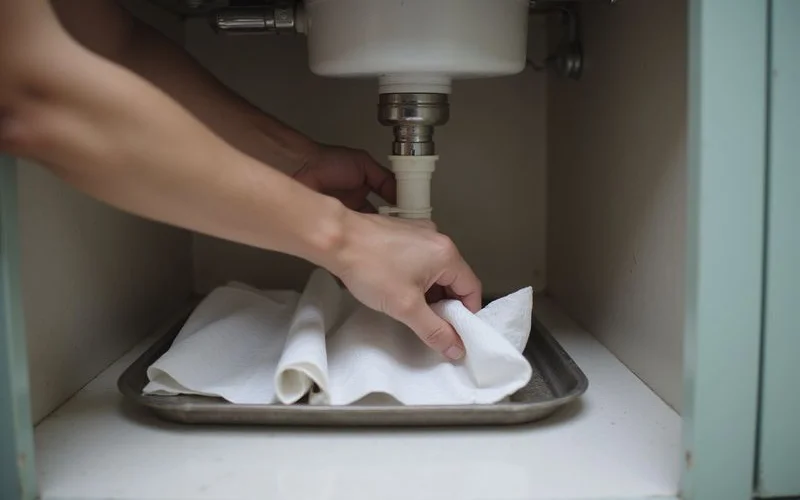
- Lay paper towel on the cabinet floor so new drips show clearly.
- Test with the tap off. Wait 15 minutes. Wet? The leak is on the supply side: hoses or valves.
- Run the tap for a minute without filling the sink. Wet now? Check the tap base and its connections.
- Fill the sink and leave it for a few minutes. Wet? Check the sink seal around the rim.
- Drain the sink. Wet? Check the waste outlet and the trap.
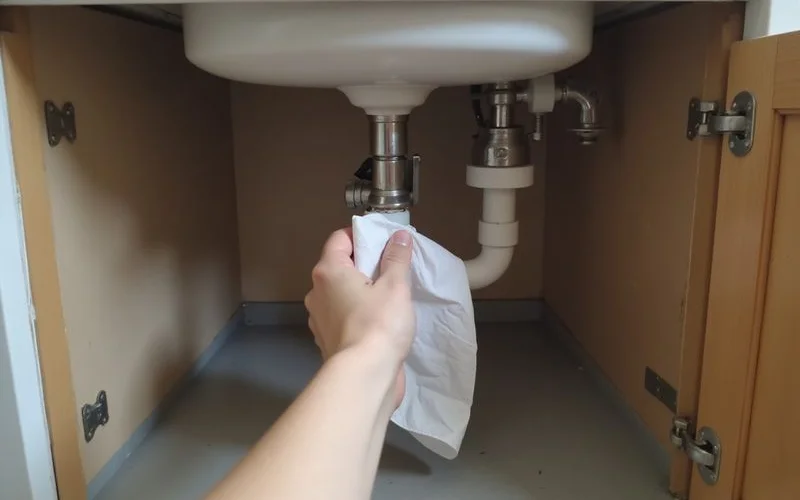
- Use dry tissue on each joint to pinpoint exactly where the water appears.
Tissue beats a finger here. It darkens at the first bead of water, even when the joint looks dry.
Fixes you can usually do
Most trap leaks come from a loose or badly seated slip nut, and you can sort those out with your hands. Keep a bucket and some paper towel nearby. If the sink itself is cracked or the cabinet base has rotted, read Replacing a Kitchen Sink or Bathroom Basin: What It Involves.
- Hand-tighten the trap’s slip nuts. Do not use force on plastic.
- Reseat the trap. Take it apart over a bucket, clean the washers and threads, check the washers sit straight, and refit.
- Tighten a loose hose connector gently, a quarter-turn at a time.
- Clean the trap while it is apart. Grease and food waste build up there.
The washer does the sealing on a slip nut, so extra force rarely helps. Over-tightening cracks plastic nuts and turns a small drip into a bigger one.
Signs a supply hose is close to failing
Replace a flexible hose as soon as you spot any warning sign below. These hoses sit under mains or pump pressure all day, so a failed one can flood a kitchen quickly.
- Rust or brown stains on the braided cover
- Bulges, kinks or frayed strands
- Damp or a white crust at the crimped ends
- A hose that is stretched tight or bent sharply
Age matters too. Australian insurer guidance, for example, puts the typical life of a braided hose at 5 to 10 years, and sooner with high pressure or poor installation. Check the hose date if it’s printed, or note the date when you fit a new one.
If you’re away for long periods, closing the angle valves under the sink is a simple precaution.
Fixes that usually need a plumber
Anything on the pressurised side, or anything sealed to the sink itself, is best left to a plumber. A wrong guess here can mean a burst or a wet floor.
- Replacing a flexible supply hose, especially one with rusted braiding. A failing hose can burst without warning.
- Replacing an angle valve that leaks at the spindle.
- Resealing the sink if the seal around the rim has failed.
- Repairing or replacing the tap if water comes from the tap body or base.
Cabinet damage
A kitchen sink leak can ruin the cabinet before you see a single drip. Many cabinets are made of particleboard, which swells when wet and does not shrink back.
Under-sink cabinets are especially prone to this. They get little airflow, so they stay damp, and swelling or peeling can show up weeks or months after the leak started.
Check under the sink every few months, and act on any damp straight away. A waterproof mat or tray on the cabinet floor gives some protection.
Partner price for reference
A dripping tap repair costs RM50 to RM400 with KL1 Plumber, read from its price list on 15 November 2026. Where your job falls in that range depends on the tap and the parts needed.
Leaks from hoses, valves, traps and seals may be priced differently. Ask for a quote that names the part.
Landed house and condo notes
Landed house. A cabinet on a ground floor slab can hide a slow leak for a long time, because nothing drips through to a room below. Check regularly, and look for a musty smell or a soft cabinet floor.
Condo unit. Water under a kitchen sink can soak into the floor and reach the unit below. Under the Strata Management Act 2013, inter-floor leaks are presumed to start in the upper unit unless its owner can prove otherwise, so fix it quickly. If your neighbour reports damp in their kitchen ceiling, check under your sink first.
When to call a plumber
Call a plumber if the leak is from a supply hose, an angle valve, the tap body or the sink seal. Call one too if tightening and reseating the trap does not stop it.
If the waste pipe drips and the sink also drains slowly, mention that when you call. A partial blockage can push water out of joints, and our Blocked Drains and Sinks section covers slow drains.
For a quote on a leaking under sink problem, note which test step showed the wet spot. Then send the plumber a photo of the part, so they can name it in the quote.