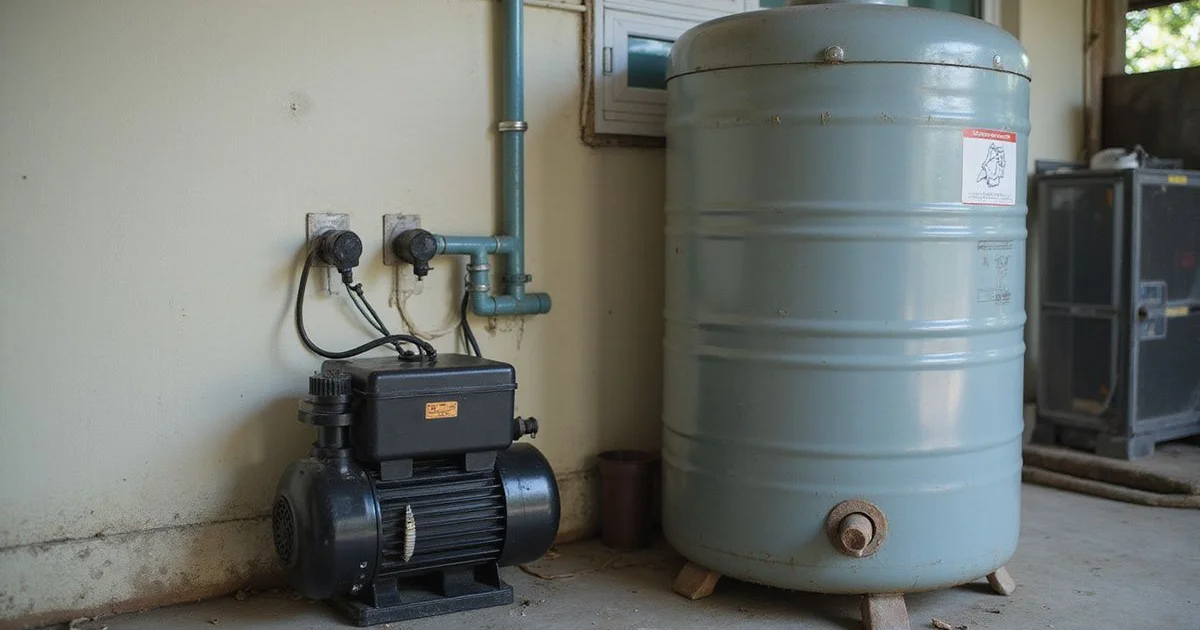
When the motor runs but nothing comes out
You open a tap, the pump starts, you can hear it running, but only a trickle comes out, or nothing at all. It is a common booster pump problem in landed houses, and the cause is usually that the pump is not getting water, or cannot move it. The most important first step is to stop the pump running dry. This guide covers the usual causes and checks. It is part of the Water Pumps section.
First: switch it off
A pump that runs without water overheats. The water normally cools and lubricates the seals and moving parts. Without it, damage can happen quickly. Switch the pump off at its own switch before you investigate. A pump that starts and stops on its own is a different fault; see Pump Switching On and Off Repeatedly.
Cause 1: an empty tank or a water cut
The simplest cause. If the tank feeding the pump is empty, there is nothing to pump.
Check:
- Is there a water cut in your area? Check Air Selangor’s notices.
- Is the roof tank or ground tank empty? Look, if you can safely reach it.
- Is the tank outlet valve closed?
If the tank is empty, wait for it to refill before you switch the pump back on. Our guide to a water cut in the Klang Valley covers protecting the pump during cuts.
Cause 2: an air lock
When the tank or pipes empty, for example during a water cut or after a repair, air gets into the suction pipe and the pump body. Many pumps cannot push air. They spin but cannot move water until the air is cleared.
Signs: it happened after a water cut or after the tank ran low. The pump sounds lighter or louder than usual.
What to do: the pump may need priming, which means filling the pump body and suction pipe with water to push the air out. Some pumps have a priming plug for this. Follow the pump’s manual, with the power off. If you are not sure how, call a plumber.
Cause 3: a suction leak
If there is a leak or a loose joint on the suction side, the pipe between the tank and the pump, the pump sucks in air instead of water. Even a small gap can stop it working.
Signs: the pump keeps losing its prime. You may see drips at joints on the suction pipe when the pump is off, or hear a sucking sound when it runs.
Cause 4: a worn impeller
The impeller is the spinning part inside the pump that moves the water. Over time, wear, sand or debris can damage it. A worn impeller turns but moves little water.
Signs: pressure has been dropping slowly over weeks or months. The pump runs normally otherwise.
Cause 5: a blocked inlet
A strainer or foot valve at the tank outlet can block with sediment or debris. Less water reaches the pump.
Checks in order
| Step | What to check | If yes |
|---|---|---|
| 1 | Is there water in the tank and is the outlet valve open? | Wait for refill, or open the valve |
| 2 | Did it start after a water cut or repair? | Likely air lock: prime the pump |
| 3 | Are there drips or loose joints on the suction pipe? | Suction leak: call a plumber |
| 4 | Has pressure been dropping slowly for weeks? | Worn impeller or blocked inlet |
| 5 | Is the pump hot, noisy or smelling of burning? | Leave it off and call a plumber |
Preventing it next time
- Switch the pump off during water cuts if the tank may run dry.
- Keep the tank clean, so sediment does not block the inlet strainer.
- Ask about dry-run protection when you replace or service a pump.
- Check suction pipe joints during your yearly check, and fix drips early.
- Know how your pump primes, by keeping its manual or a photo of the instructions near the pump.
Dry-running damage
If a pump has run dry for a long time, it may be damaged even after the water is back. Signs include leaking from the pump body, unusual noise, or a pump that still gives weak pressure after priming. Some pumps have dry-run protection that switches them off. Ask about it if you are replacing a pump.
Landed house and condo notes
Landed house. Pumps are usually fed from a ground or roof tank. Most problems start with the tank, so check it first.
Condo unit. If the whole building has no pressure, the building’s pumps or tanks are the issue. Report it to building management.
When to call a plumber
Call a plumber if the tank has water but the pump still gives no pressure, if it keeps losing its prime, if you see leaks on the suction pipe, or if the pump is hot, noisy or leaking. The partner plumber’s pump inspection fee, and whether it is waived, is listed in the Water Pumps section. Ask any plumber how they charge before the visit.