Fix it or change it?
A small leak at a roof tank rarely stays small. A weeping fitting or a cloudy tap can turn into a stain across your ceiling.
If you’re trying to decide whether to repair or replace a water tank, the short answer is this: fix leaking fittings and dirty water, but replace a tank whose body is cracked, rusted through or bulging. Three things settle the call: where the problem is, how old the tank is, and how easy it is to reach.
We see this often in Klang Valley landed homes. Many owners replace a tank that only needed a clean. Others patch a tank that was past saving.
Malaysian guidance commonly puts tank cleaning at every 6 to 12 months. So a tank that has missed a few cycles may only need a good clean.
Below, we cover what can be repaired and what points to replacement. Then we look at age, access and a simple checklist you can run yourself. This guide is part of our Water Tanks section.
Repairable problems
Most fitting, valve, lid and cleaning problems are repairable, and they cost far less than a new tank. These are the usual ones:
- Leaking fittings. The inlet, outlet or overflow connections can leak because a seal has worn or a fitting has loosened. Replacing the fitting or seal often fixes it.
- Faulty float valve. An overflowing tank usually needs a new washer or float valve, not a new tank. Our guide to a water tank overflowing covers this.
- Dirty water and sediment. Cleaning the tank usually solves it.
- A damaged or missing lid. Replace the lid.
- A leaking outlet valve. Replace the valve.
The lid matters more than it looks. The Star ran a piece in November 2024 urging people not to neglect their tanks, noting that animals such as rats, birds and snakes can get in through damaged vents, holes or gaps. A cheap lid or vent repair keeps them out.
Problems that usually mean replacement
If the tank body itself is failing, replace it. A repair on a failing body rarely lasts. These are the warning signs:
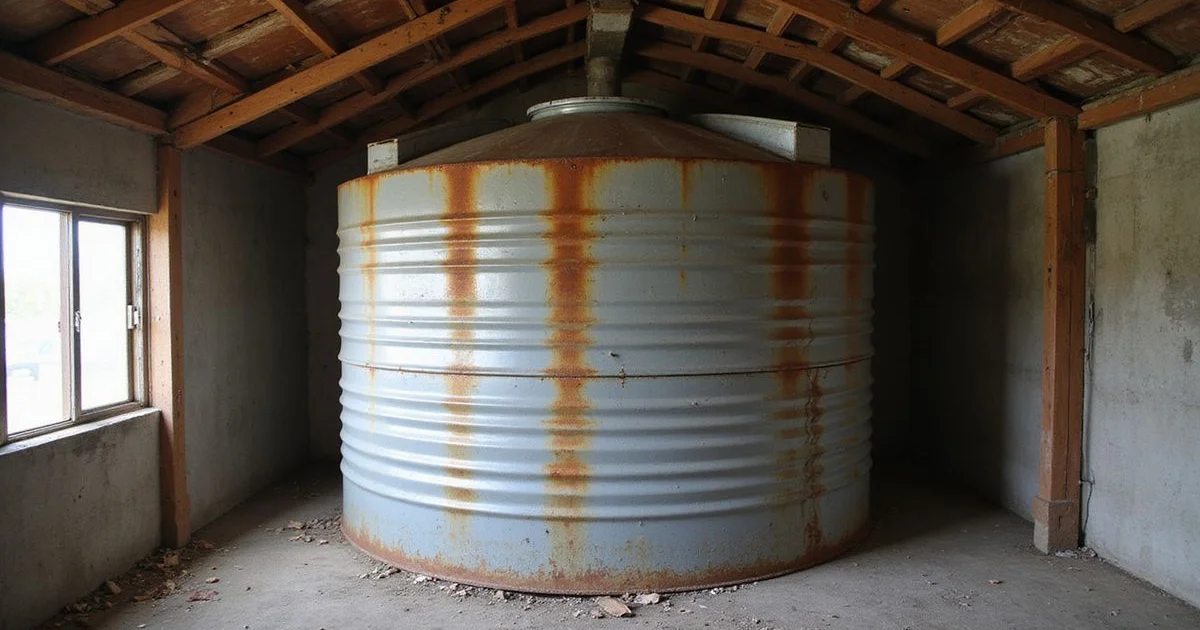
- Corrosion of a steel tank body, especially rust holes or rust at the welds.
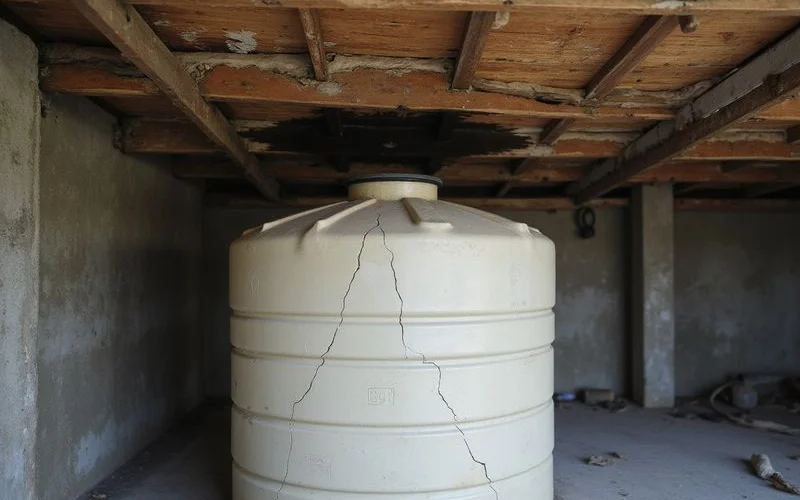
- Cracks in a plastic tank body, often from age, sun or overtightened fittings.
- Bulging or deformed tank walls.
- Repeated leaks from different places.
- A tank that is too small for the household, or too big for its support.
- An old tank with several problems at once.
Surface rust on a bolt or fitting is a different matter. You can often clean that off. Rust that starts from the tank body is permanent, and it spoils your water quality.
Sun is the usual enemy of plastic tanks. Over the years it makes plastic brittle, so a hairline crack can appear even if nobody has touched the tank.
Age matters
There is no fixed lifespan for a tank, but age raises the odds that a repair will not last. Suppliers often quote about 10 to 15 years for a standard plastic tank. For stainless steel they often quote 15 to 25 years in Malaysian conditions. Treat those as supplier estimates, not guarantees.
Here is how we weigh it:
- Old tank, one leaking fitting: worth fixing.
- Old tank, corrosion plus a leaking fitting: usually better replaced, because the next problem is not far away.
Access to the roof space
Access affects both repair and replacement, so check it before you decide. Hard access adds time and cost to either job. Ask yourself:
- Can the old tank come out through the roof hatch, or does it need to be cut up?
- Can a new tank go in? Some tanks come in sizes or shapes that fit small hatches.
- Is there a safe platform for the plumber to work on?
- Is the tank on an outdoor stand? Stands can be easier to reach but may need checking for rust.
Partner prices for reference
For a rough budget, KL1 Plumber publishes these prices on its price list, read on 15 November 2026:
| Job | Published price |
|---|---|
| Clean water tank | RM200 to RM300 |
| Replace water tank | RM500 to RM1,000 |
These are the partner’s own published prices, not market averages. Where a job falls in the range depends on the tank size and type, access, and any extra work such as new pipes or a new platform.
The gap is useful. If your only problem is dirty water, a clean costs a fraction of a new tank, so rule that out first.
How to inspect the tank yourself
If you can reach the tank safely, a quick look tells you a lot. Go early in the day, take a torch, and stand only on boards or a proper platform.
- Outside the tank: look for rust stains, damp patches, white mineral crust or drips, especially around the fittings and the base.
- Under the tank: check the platform or stand for rot, rust or sagging, and the ceiling board for stains.
- The lid: is it intact and well fitting?
- Inside, with the lid off: look at the water. Is it clear? Is there sediment on the bottom, slime on the walls or anything floating?
- The float valve: does it shut off cleanly when the tank is full?
- The overflow: is it clear and running outside, not into the roof space?
Take photos. They help a plumber quote without guessing, and they give you a record for next year.
A simple decision guide
Match what you found in the inspection to the table. If two rows fit, go with the more serious one.
| What you find | Best next step |
|---|---|
| Leak at a fitting, tank body sound | Repair the fitting |
| Overflow running | Repair or replace the float valve |
| Dirty water, no damage | Clean the tank |
| Rust spots on a steel tank body | Replace, or have it checked closely |
| Crack in a plastic tank body | Replace |
| Several faults on an old tank | Replace |
| Tank too small for the household | Replace with a larger one, checking the support |
Choosing a replacement
If you decide to replace, pick the size and material with care. A new tank should last longer than the old one, and the wrong choice can repeat the same problem. Our comparison of stainless steel and polyethylene water tanks covers durability, weight, algae and sizing.
Check the weight of a full tank against your platform before you order. A bigger tank on a weak support is a common reason for a second failure.
Damage below the tank
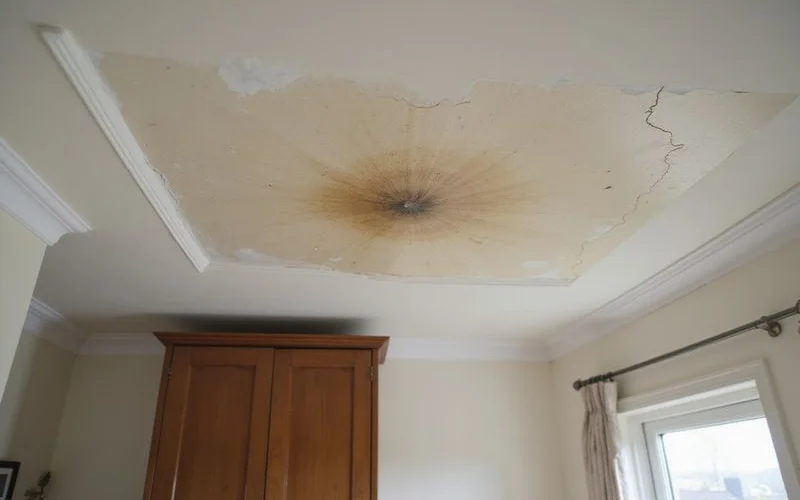
A leaking tank often shows up first as a stain on the ceiling under it. Once the tank is fixed, the ceiling board may need drying or replacing. Ask whether that is in the quote, or whether you need someone else for the ceiling.
Landed house and condo notes
Landed house. Roof tanks are the owner’s responsibility. Put a tank check on your yearly list, and clean the tank every 6 to 12 months.
Condo unit. Shared tanks are building management’s responsibility. If tap water in your unit is dirty or smelly, ask management when the building tanks were last cleaned.
When to call a plumber
Call a plumber if the tank leaks, if water is dirty and does not clear after cleaning, if you see corrosion or cracks, or if you cannot safely reach the tank to check it. A plumber can tell you in one visit whether to repair or replace your water tank.
Ask for a written quote that says whether the tank can be repaired. If it can’t, the quote should give the size, material and brand of the replacement. Send your inspection photos ahead so the quote starts from facts, not guesses.