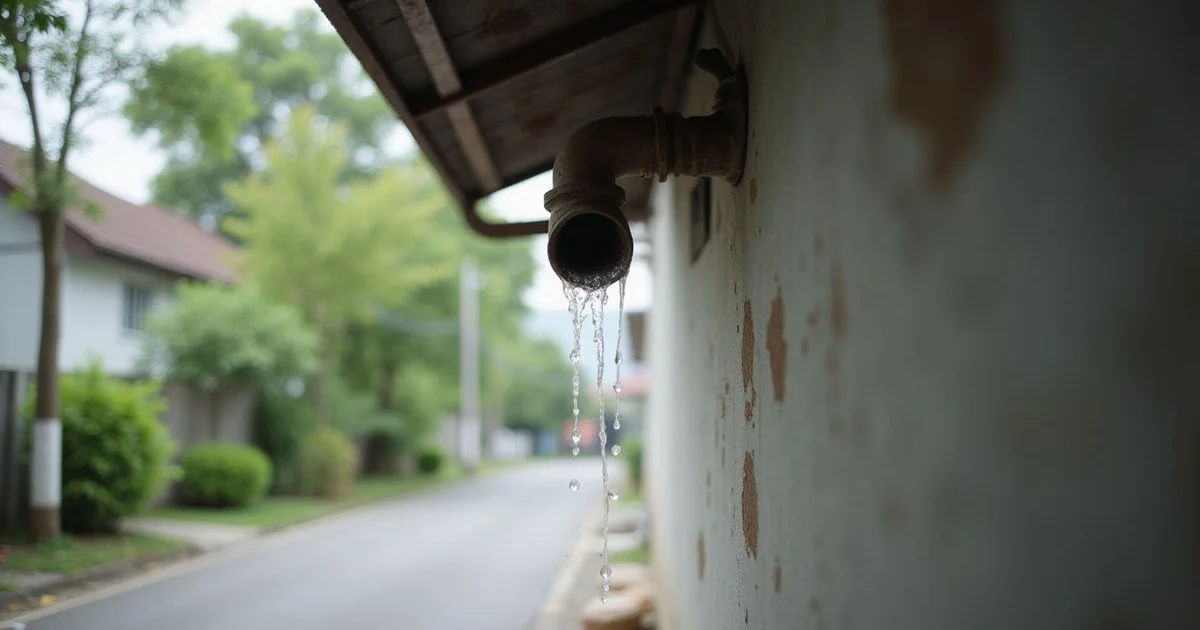
What an overflow is telling you
Every roof tank has an overflow pipe, usually running out through a wall or the eaves. Its job is to carry water safely outside if the tank ever fills too high. It should be dry nearly all the time. If you see it dripping or running, water is coming into the tank faster than the tank should allow, and it is going straight out of the house. This guide explains the usual causes, the risks, and what you can safely check. It is part of the Water Tanks section.
How the tank fills and stops
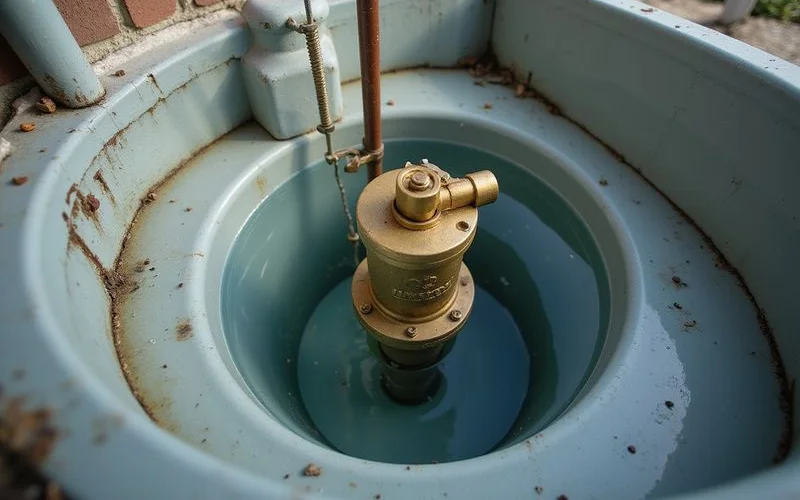
The tank fills from the mains through a float valve, often called a ball valve or ball cock. A float on an arm rises with the water. When the water reaches the right level, the float pushes the valve shut. When you use water and the level drops, the float drops, the valve opens, and the tank refills. If the tank itself is rusty or cracked, weigh up Water Tank Repair or Replacement?
If the valve does not close fully, water keeps coming in. Once the level reaches the overflow outlet, the extra runs out of the overflow pipe.
Common causes
- Worn washer in the float valve. The rubber washer that seals the valve wears out and lets water through.
- Stuck or snagged float, caught on the tank wall, the lid or a pipe so it cannot rise fully.
- Float set too high, so the valve shuts above the overflow level.
- Damaged or waterlogged float. A cracked float fills with water and no longer floats properly.
- Grit in the valve after a water cut, which stops it sealing.
- High mains pressure, which some older valves cannot hold back.
The risks
- Wasted water and higher bills. A constant overflow wastes water day and night.
- Ceiling damage. If the overflow pipe is blocked, cracked or disconnected, water may spill inside the roof space and soak the ceiling below.
- Wall damage. An overflow that runs down an outside wall for months can stain and damage it.
- Confusing leak tests. It makes the meter move, which can be mistaken for a pipe leak.
If a stain appears on the ceiling under the tank, read Roof Leak or Pipe Leak? to work out where it is coming from.
Safe checks in the roof space
Only do these if you can reach the tank safely, with proper access, boards to stand on, and good light. Go early in the day, before the roof space heats up.
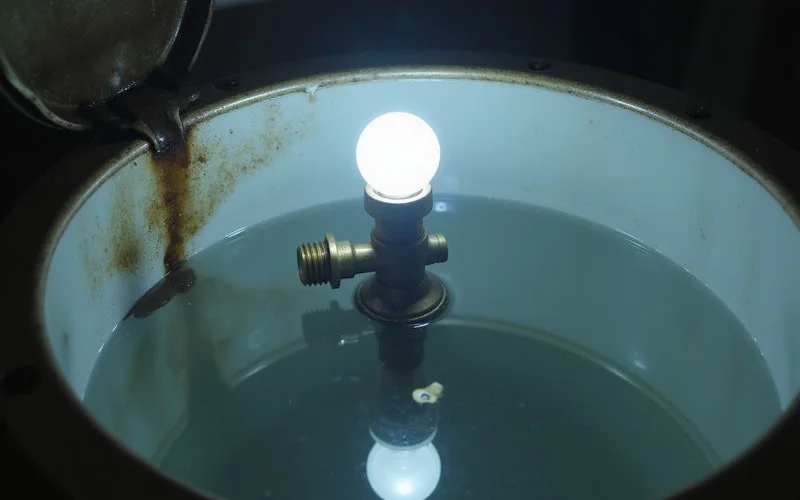
- Lift the lid and look at the water level. Is it at or above the overflow outlet?
- Look at the float. Is it touching the tank wall, the lid or another pipe? Free it gently.
- Lift the float arm gently. If the water stops coming in, the valve can shut, and the float may just need adjusting.
- Check the float itself. Does it feel heavy, as if water is inside it?
- Look for damp under the tank, around the fittings and along the overflow pipe.
- Close the lid properly afterwards to keep dirt and insects out.
Do not lean on the tank or stand on ceiling boards. If the float valve needs dismantling, that is a plumber’s job.
Temporary measures
If the overflow is running badly and you cannot get it fixed today:
- Tie the float arm up gently so the valve stays shut, if you can reach it safely. Remember to untie it once the tank needs to refill.
- Or close the valve on the supply pipe into the tank, if there is one, and open it now and then to top up.
These are short-term only.
Partner prices for context
Most overflows are fixed by repairing or replacing the float valve, which does not appear as a separate item on the partner’s published list. For context, KL1 Plumber publishes prices of RM200 to RM300 to clean a water tank and RM500 to RM1,000 to replace a water tank, read from its price list on 15 November 2026. If the tank is old, corroded or leaking as well as overflowing, those are the jobs that may come up.
Landed house and condo notes
Landed house. Roof tanks and their float valves are the owner’s responsibility. Check the overflow pipe during your yearly check.
Condo unit. Shared tanks belong to the building and are managed by building management. If you see water pouring from a building overflow, report it to the management office.
When to call a plumber
Call a plumber if the overflow keeps running after you have freed and adjusted the float, if the float or valve is damaged, if water is leaking inside the roof space, or if you cannot reach the tank safely. A float valve repair is usually a small job, and fixing it quickly saves water and protects your ceiling.