The question every rental faces
A blocked toilet in a rented home can turn into an argument fast. The question is simple: does the landlord or tenant pay for a blocked toilet?
In most Malaysian rentals, the answer depends on two things. One is what caused the blockage. The other is what the tenancy agreement says.
Malaysia has no Residential Tenancy Act in force as of 2026, so the contract does most of the work. That’s why we always start with the agreement.
We’ll cover the usual approach, how to find the cause, and how to avoid a rental plumbing dispute. This is general information, not legal advice. For the wider topic, see the Landlords and Tenants section.
Misuse or pipe fault?
Misuse usually means the tenant pays, and a pipe fault usually means the landlord pays. This table shows the common patterns.
| Cause | Usually pays | Why |
|---|---|---|
| Wet wipes, sanitary pads, nappies, cotton buds flushed | Tenant | Misuse of the toilet |
| Too much toilet paper in one flush, once | Often tenant, depends on the agreement | Use, not a fault |
| Toys or objects dropped in | Tenant | Accidental misuse |
| Old, cracked or collapsed pipe | Landlord | Wear and tear or a fault |
| Badly sloped or undersized pipe | Landlord | Fault in the property |
| Tree roots in the drain | Landlord | Not caused by the tenant |
| Blocked shared stack (condo) | Building management | Common property |
| Public sewer blockage | Indah Water Konsortium (IWK) | Public system |
The first three rows come up most often. Indah Water Konsortium (IWK) lists wet wipes, nappies, sanitary pads and cotton balls among the items that clog sewer pipes. That’s why a plumber who pulls out a wad of wipes will point to the tenant.
These are general patterns. The tenancy agreement always comes first.
What the plumber’s finding means
The plumber’s finding is the best evidence you’ll get. They’re usually the only person who sees what’s actually in the pipe.
Ask the plumber to:
- Tell you what caused the blockage, in plain words.
- Photograph what they pulled out, or the pipe problem they found.
- Write it on the invoice or receipt, for example “blockage cleared, cause: wet wipes in outlet”.
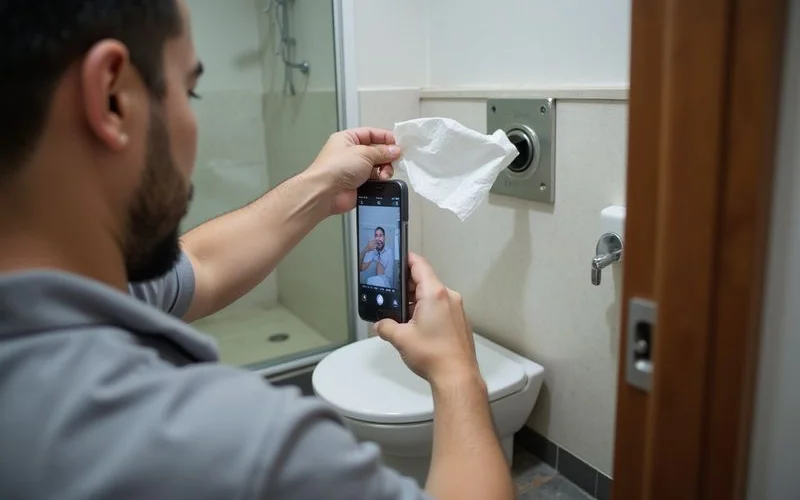
A dated photo and a written cause settle most arguments before they start. Without them, it’s one person’s word against another’s.
If the cause was a pipe problem, ask whether it’s likely to happen again and what would fix it for good. Landlords will want to know.
Check the tenancy clause
Start with the repairs clause. Most Malaysian tenancy agreements have one, and it decides who pays when the cause is unclear. Landlords can head off many of these disputes with the plumbing checks between tenants, which record how each toilet and drain works before a new tenancy starts.
Look for:
- Who is responsible for minor repairs, sometimes up to a set amount per repair
- Who is responsible for damage caused by the tenant’s misuse
- How the tenant must report problems, and how fast
- Whether the tenant may arrange repairs and claim the cost back
Many local agreements make the tenant pay for minor repairs below a set sum. RM200 is a common benchmark, with the landlord’s written approval needed above it. Check your own figure, because it varies from contract to contract.
If the clause is unclear, talk to each other early, before the plumber arrives.
Partner price for reference
A published price helps both sides judge a quote. KL1 Plumber publishes a price of RM65 to RM430 to clear a toilet bowl blockage, read from its price list on 15 November 2026.
Where a job falls in that range depends on:
- How deep the blockage sits
- How stubborn it is
- How hard it is to reach
The Plumbing Costs section has the partner’s other published prices.
A fair process for both sides
A fair process starts with fast, written communication. Here’s what works for each side.
For tenants:
- Report the blockage to the landlord or agent quickly, in writing, with photos.
- Try a plunger first if you can do it safely.
- Do not keep flushing.
- If you arrange the plumber yourself, agree with the landlord first who will pay.
For landlords:
- Respond quickly. A blocked toilet makes a home hard to live in.
- Agree who will call the plumber and who will pay if it is misuse.
- Ask for the plumber’s finding before deciding.
- If it was a pipe fault, fix the cause, not just the blockage.
Landed house and condo notes
Where the blockage sits changes who is responsible. Landed houses and condos work quite differently.
Landed house
If the blockage is outside the house, the cause is more likely the drain itself. Think of an inspection chamber or the line to the sewer, with roots, silt or a sagging pipe. Those are usually the owner’s.
If the public sewer is blocked, contact Indah Water Konsortium (IWK). IWK says it clears sewer blockages through the manholes, with a target of 24 hours from notification.
Condo unit
If water backs up when the unit above uses water, the shared stack may be blocked. Under the Strata Management Act 2013, the management body (JMB or MC) maintains common property, which includes pipes that serve more than one parcel. That makes it building management’s job, not the tenant’s or the landlord’s.
Report it to management straight away. Our guide on water coming up from the floor trap explains how to tell.
When the cause is unclear
Sometimes the plumber can’t say for sure. A little toilet paper and a slightly sagging pipe may both play a part.
In that case, there are two common ways to settle it:
- Share the cost between landlord and tenant.
- The landlord pays the first time, and both agree on house rules to prevent a repeat.
Whichever you choose, write down what you agree. A short message or signed note is enough, and it protects both sides if the same problem returns.
Preventing the next one
Most blockages are avoidable. These habits keep the pipes clear:
- Put a bin with a lid in every bathroom.
- Include “nothing but toilet paper in the toilet” in the house rules.
- Show new tenants the bins and the main water valve at handover.
Our guide on what not to flush is worth sharing with tenants.
Confirm before you act
This is general information, not legal advice. Your tenancy agreement and its wording decide most disputes.
If you can’t agree, get qualified advice. For disputes with a condo management body, the Strata Management Tribunal hears claims up to RM250,000.
When to call a plumber
Call a plumber if a plunger doesn’t clear the blockage, if water rises to the rim, or if blockages keep coming back. Tenant blocked toilet responsibility usually comes down to the cause and the contract, so settle both early.
Before the plumber starts, agree who is paying. Then ask them to record and photograph the cause.